This "Enlightenment" section
here has many of the most eye-opening articles.
The overall theme here are articles for which common belief significantly differs from the reasonable conclusions.Enlightened skepticism promoted also considers the harm arising from ignornace.
“Enlightenment” & “Utilitarianism" are the oldest two addresses under "skeptically.org".
"Enlightenment" is the beginning;
started in 2001. Many of the most eye opening articles (contrary to the beliefs of the common herd) are found here in
Enlightenment.
Updated 4/23/12
This site is one
of 3 sites maintained by California Skeptics
All with cool art
and informative articles
To see the latest
articles go to table of contents.
New articles are in blue
A= Art with some of the articles.
All home pages have art.
#31 TABLE OF CONTENTS healthfully, 1,500 evidence based medical articles organized
by
topics over 1,200 pages downloaded per day.
Sections on worst drugs and the games PhARMA plays to maximize profits,
including misinformation about aspirin and hormones A
NEW SITE:CURRENT POLITICS INCLUDING LINKS TO OVER A DOZEN A+++
MUSICAL CARTOONS ON THE CANDIDATES.
This site, once the skeptical-educational efforts of JK, it is now currently being
revised to reflect the varied interests of members of the skeptical group of San Diego, and thus the content of a non-skeptical
nature are being removed, and placed in the linked site jerrymondo. (Other member sites will be found linked in
suitable locations.) This revision of this site will take some time, for there are many articles which we desire
to add to this site and many others to move, and only two have volunteered to continue working upon the site.
The essays
which follow are exercises of our rational nature. They also disabuse certain all too common errors
in factual foundations and logical inference. Taken as a whole, the articles contain a scientific explanation of the Nature of Things (as understood by the Greek atomist school of philosophy).
The
reference to Socrates (below the title "ENLIGHTENMENT") alludes to his assertion--according to Plato--that the God Apollo
required of Socrates that he teach the citizens of Athens to know themselves. Philosophy
lies at its core. The Greek philosophers of all schools shared a vision of the ideal citizen. California Skeptics feel
that Apollo is looking over our shoulders.
WHY BOTHER?
You probable wonder why I have done this.There
is the psychological answer: I like working on this site because of intellectual
pleasures and the relief of boredom; viz., I get more reinforcements from this activity than others for approximately
20 hours per week.And there is the conceptual answer:the combination of the fulfillment of the utilitarian imperative of doing the greatest good, and Hope (the
chance that this would lead to something bigger). I am unloading years
of learning and paper collecting. I am driven by the urge to arrive at the best
conclusion based upon the evidence. Nearly all that I have pasted is for the sake of helping both you and
me rise above our animal side and become logical. Secondly, it is to prmote ataraxia, read (Love of all things as foundation for happiness). The Greek
philosophers held that the quite enjoyment from a mind that is at peace and delights iin studies is an important part of living
the good life--elements of ataraxia. I started this pursuit again of the academic once the 6-year break pot smoking
break, which ended in 1976 with my enrollment again in college (I had completed 2-years of graduate school in 1970).
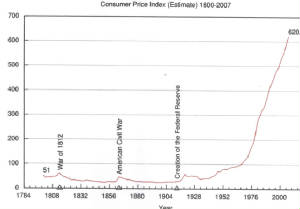
Notice
what has happened to the Consumer Price Index (CPI), this is because the Federal Reserve and particular
and the financial community in general defacto control our economy. Our government prints money for the
banks to loan out (their principle source of income). Printing money causes inflation, and it also caused this and the last depression.
Debt payments are the 2nd largest item in the federal budget (over $400 billion). Our Federal Reserve System was modeled
on those in Europe, which is why the economic collapse is world wide. One cannot understand
U.S. government’s
relationship with the business-banking sectors, or U.S. foreign
policy without understanding the role of the Federal Reserve and other national-banking systems.They are the foundation of the 3-headed Hydra, the IMF, WTO and World Bank.To learn more on banking http://www.freedocumentaries.org/film.php?id=214.
A humane skeptic is one who not only believes in proportion
to the evidence in support thereof, but also accepts utilitarian ethics and therebyseeks to improve the condition of mankind in
according to the measure of harm-and-happiness. If nearly all people saw half as deeply as Plato or Jeremy Bentham we would
overturn our old apple cart.
To him who little is not enough, nothing is enough--Epicurus
Original sin is the difference between my pleasures and yours--B.F. Skinner
Moreover, JK has something to say, and he likes saying
it.He has written several works of fiction in need of a publisher.Can you help?
Just as Socrates/Plato wrote on many things, to which the totality thereof constituted an overall weltanschauung, for which
only an extensive reading of the works of Plato along with an understanding of the issues he addressed would open the doors
of their perceptions; so too does the collection of material presented by me require a reading to understand my mind and how
thus how I have taken their foundation and adapted it to the truths of our era.
In order to know what is one must know what isn't. This site addresses popular delusion,
and also to provide the tools to recognize delusions.
MEDICAL LINKS
This site is one of 3 sites maintained by California Skeptics
All with cool art and informative articles 9/6/18
#31 TABLE OF CONTENTS healthfully, over 1,200 pages downloaded per day.
#7 TABLE OF CONTENTS skeptically, over 8,000 pages downloaded per day.
#201 TABLE OF CONTENTS CURRENT NEWS , over 900 pages downloaded per day
#209 THE ARTISTS
# 180 RECOMMENDED WESTERN DIET PANDEMIC, high fructose diet and its conditions—proofs
#158 RECOMMENDED GATEWAY PAGE Gateway to the research on pharma and health
#152 RECOMMENDED--CONCISE Bad drugs, good drugs, treatments & supplements,
#161 RECOMMENDED HEALTHFUL Improving health including diet and nutritional science
#185 RECOMMENDED FRUCTOSE PAMDEMIC BOOK fructose makes us sick book in preparation
#157 Video documentaries lectures YouTube Healthful diet, bad pharma, GMOs etc. with description
Link to more of these cartoons
Danish cartoons that started riots in 2/06
The Greek Philosophers self-servingly (for
they were the teachers) held that an essential condition for the development of right character of the upper class citizens
consisted in instructing their sons in philosophy (which in those times also included the now separate fields of sciences,
social science, political science, mathematics, and literary analyisis) so that their rational nature could guide
their actions and thus dominate in prudent ways over their animal side. Their students would learn to be free through
rational understanding the frightful superstitious beliefs of the masses including their brand of religion. As their
students developed they would come to understand the conditions necessary to live the good life and have sufficient to
control--if not abjectly poor--to fulfill those conditions. The good life included in--given the unstable political conditions--fulfilling
obligations to the state, so as to avoid becoming an outcast. It also consisted of living in moderation, of having control--as
a rational animal--over ones desires, to seek the purer pleasures, of which those arising from quite contemplation while being
at peace with oneself ranked as the purest. A person living the good life exercised and participated in sports, enjoyed the
fine arts, was honorable, had a group of noble companions, and of course had the skills of a philosopher (the term which means
"lover of wisdom).
There were of course disagreement among the different schools of Greek Philosophy, but compared to their agreement about the
good-life, it was minor. Epicurus as leader of the Greek Atomists best and succinctly voiced what the good-life is. A revival
of his teachings occurred with Gassandi--and others--in 17th-century Europe. This culminated with utilitarianism (see my
other site). I hold this theory of ethics to be an improvement upon the Greek Ethics in its metaethical foundation and prescriptions
for society. Utilitarianism in my life occupies a place comparable to that of a religion, but without the need
to believe in that which given the totality of evidence is quite unbelievable.
Boris Artzybasheff
M.C. ESCHER
link to recreational drug site
Original sin is the difference between your pleasure and mine--B F Skinner
Now averaging over 3 1/3rdmillion
pages viewed per year
64,234 x 52 = 3,340.668
General Summary
1.
Host name
jeromekahn123
2.
Program start time
Mar 12, 200802:07
3.
Time of first request
May 31, 200403:47
4.
Time of last request
Mar 11, 200823:59
5.
Time last 7 days lasts until
Mar 12, 200802:07
6.
Successful server requests
6,317,380 Requests
7.
Successful requests in last 7 days
64,224 Requests
8.
Successful requests for pages
3,600,122 Requests for pages
9.
Successful requests for pages in last 7 days
64,224 Requests for pages
Your sitehad 11132 page views yesterday and 261227
page views so far this month.
This report
was generated on March 12, 200802:07. Report time frame May 31, 200403:47 to March 11, 200823:59.This site
has been up since the spring of 02
.
This is where skeptically.org began, March of 01.With the encouragement of Alan Peters the site /enlightenment was born.The articles here expose the major common fallacies:that the world is
better for religion, that there is a beneficent Creator, that the laws physics (and nature) prove divine design, that
the ancient Hebrews were in Egypt, that there is historical and reliable (independent
of religious writings) information on the lives of Mohammed and Jesus Christ, that the U.S. criminal justice system upholds
the Bill of Rights (sound principles of jurisprudence), that our political-economic system is a blessing, and the benefits
of big PHARMA.Other sites in the
skeptically.org family expand the issues raised in enlightenment and others branch out into the critical examination alternative
medicine (including chiropractics), psychic phenomena, mind based psychology
and psychiatry, the performance of our president and legislature, economics, nuclear bombs and the Iraq war, & the war
on drugs--to name the principal.A large portion is a resource in religious studies
with many ancient works and modern critical works.To increase the number of
visitors, there are several art works on each home page, a section of cartoons, and many, many links to other sites.
#31 Health, medical science, drugs:an encyclopedic collection of articles on assorted medical & health issues.The best on the web.Science (evidence) based articles
on all the major health issues including cancer, obesity, tobacco, back pain, ulcer & heart burn, dubious drugs and medical
treatments, male & female hormone replacements, NSAID & aspirin, longevity, introns stem cells and other important
basic medical science.Over 200 articles, plus a large collection of fascinating
art.
OUTSTANDING SITES
QuackWatch, guide to health fraud by Dr. Stephen Barrett
The skeptic is one who
judges all things according to the evidence. The common herd affirms many things to
a degree well beyond what the evidence supports; and conversely doubts that which is worthy of greater affirmation.The humanistic skeptic applies a second measure, that of harm resulting from such beliefs.Issues of economics and politics, of religion,
quackery and corporate medicine, and of imprudent behavior top the harm done list.Education and scientific psychology are gateways to following the dictates of reason.